Many people today are not acutely ill. But they are under constant strain. A constantly overstimulated nervous system means a permanent state of alert.
Not loud. Not dramatic. But constant.
And constancy is the decisive factor:
A system that never fully powers down is not living in an emergency—but it is also never in true recovery.
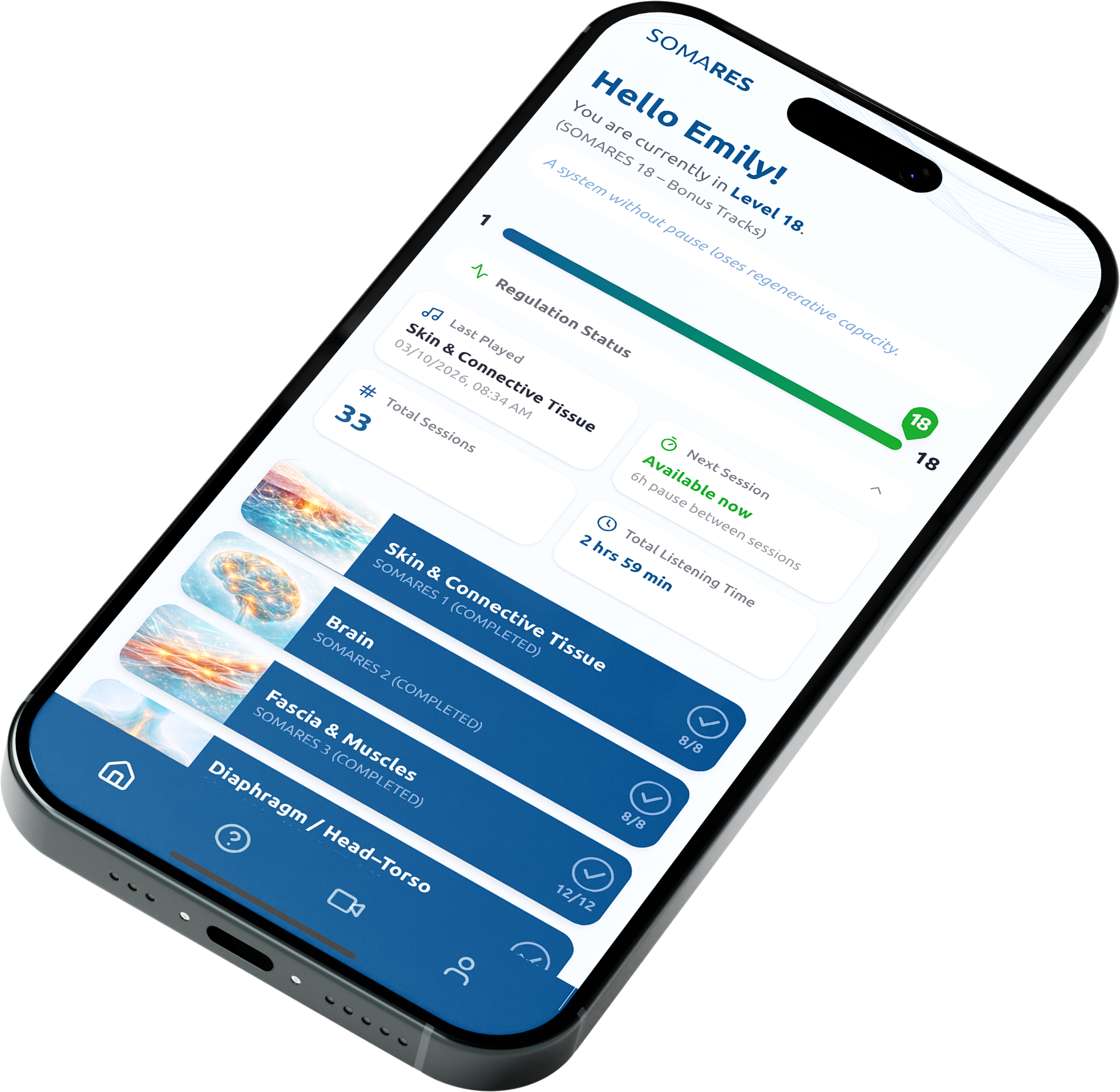
SOMARES is a structured regulation system—structured, repeatable, measurable.
then 365 EUR in the first year when signing up for a subscription
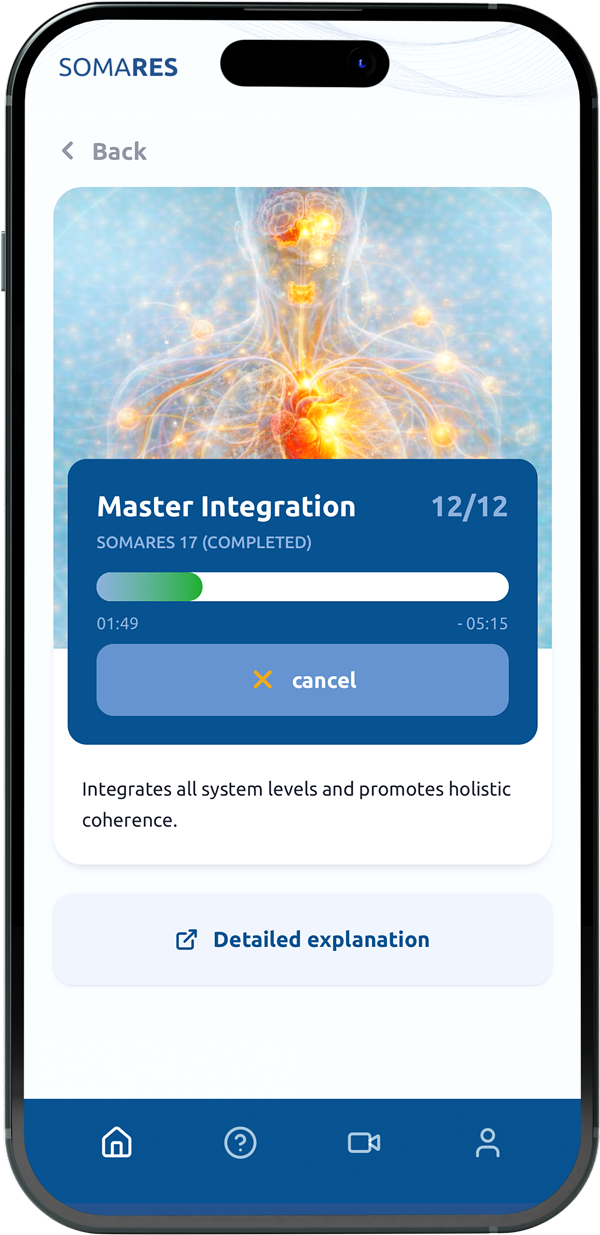
Get to know SOMARES: Dr. Peter Backwinkel explains the application and its effects clearly and concisely.
We live in an environment our biological system was not built for:

Even when we are sitting.
Even when we are sleeping.
Even when we are doing “nothing.”
The system keeps running.
Not in emergency mode—but in a subtle, constant activation.
And that is the insidious part: because it feels “normal.”
Many people can hardly tell the difference anymore between:
“I am tired” and “My system is no longer regulated.”
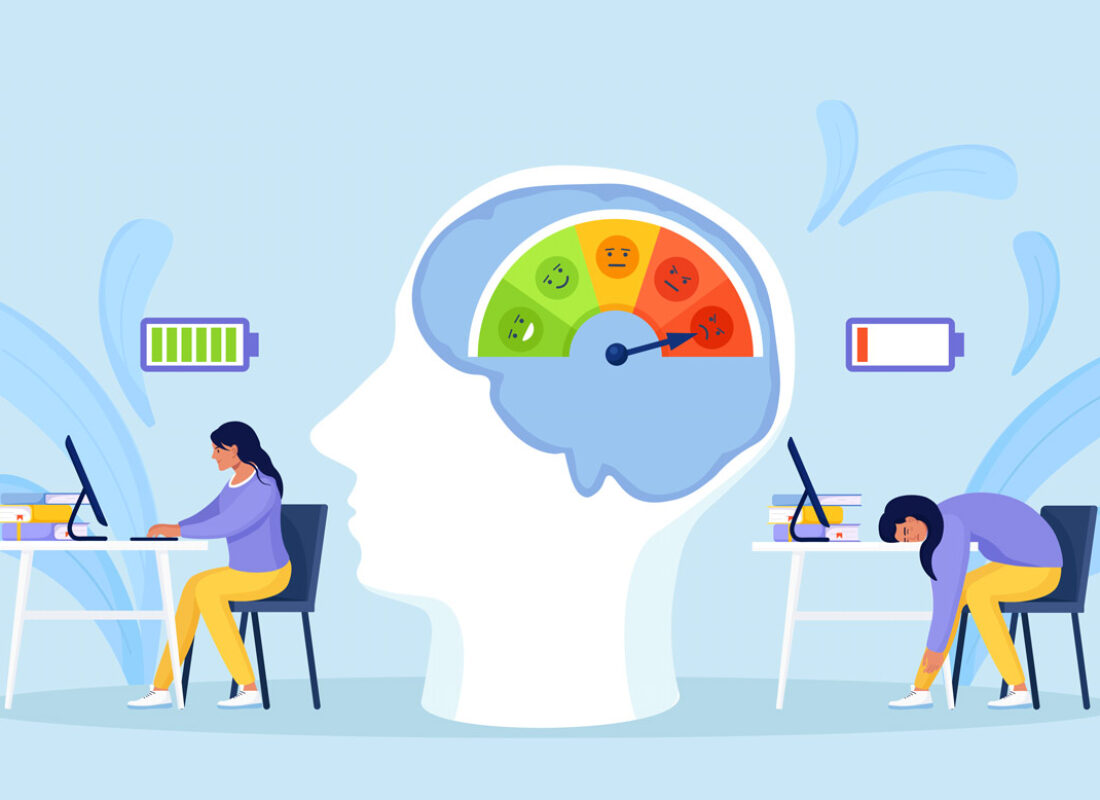
What is missing is hard to pin down: calm. Capacity. True regeneration.
Not as a dramatic illness.
But as a gradual system overload.
A constant state of alert in the background.
A constant state of alert costs energy.
Not only physically—but also neurobiologically.
And energy is the foundation for:
If your system remains tense over the long term,
it often lacks the capacity for precisely these processes.
Chronic conditions rarely arise suddenly.
They develop step by step.

The body no longer fully returns.
Not because it is “broken.”
But because it is never allowed to fully enter regulation.
A system that is constantly activated cannot sustain deep relaxation. The resting state is no longer reliably available.
Those who try to “power down” directly often experience:
with a rapid relapse
The nervous system no longer has a stable resting state.
And this is exactly where many approaches fail.
Because an overstimulated system cannot simply be “talked into it.”
But an overstimulated system needs something else:
Guidance. Structure. Consistency. Safety.
A clear, repeatable framework that guides your system step by step out of constant alert —back into stability.
with a clear structure
guided, built up, in sequence
through repetition
SOMARES does not replace medical treatment. It supports natural regulation processes.
Developed based on over 25 years of research into neurophysiological interactions and measurable brain activity patterns.
Our analyses show:
When the nervous system is guided in a structured way, it measurably begins to stabilize again.
Try it free for 14 days
365 EUR in the first year · then 30 EUR per month
SOMARES follows a clear sequence:
Each level stabilizes the next, because biological regulation is organized hierarchically.
No stability without a foundation:
No emotional relief if the nervous system is operating in alarm mode. No deep sleep if stress axes and neuronal activity are elevated.
And stability is the foundation for everything that follows.
They work in the short term—but they do not guide the system.
Step-by-step restoration of regulation.
Regulation does not mean always being calm, but rather:
A regulated system can perform and let go.
Many people know only one mode—and that is exactly the problem.
a promise of healing,
an emergency tool,
a biohack,
"listen once and everything changes."
structured,
repeatable,
measurable—and precisely for that reason sustainable.
Somares is suitable for you
When your nervous system can regulate again, it is not only how you feel that changes.
Processes change, too.
Not as a short-term effect—but as a stable new foundation.
And stability is the foundation for everything that follows.
For optimal playback of the SOMARES audio frequency programs, we recommend wired over-ear headphones. This allows the included frequency information to be reproduced as precisely, consistently, and unaltered as possible.
Bluetooth headphones are not suitable, as wireless transmission can involve additional signal processing and compression.

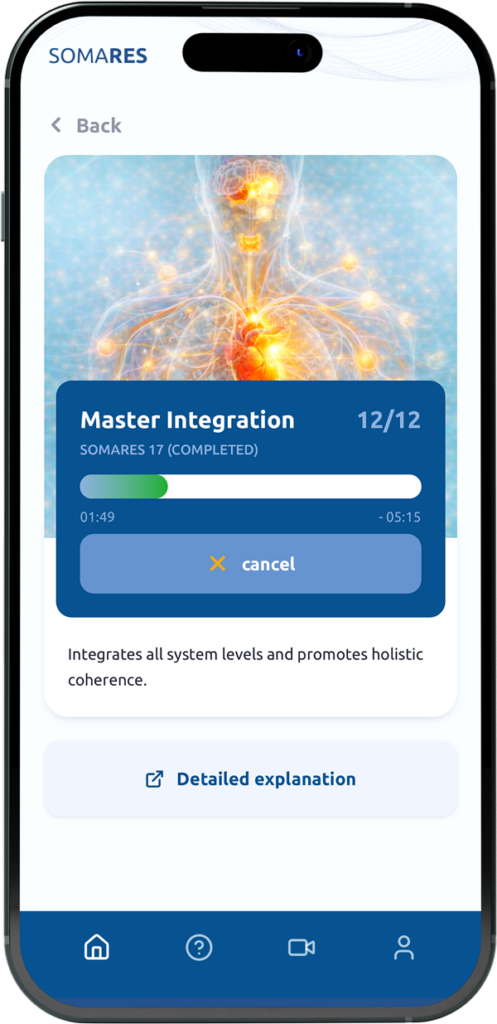
Start SOMARES as a sustainable, structured system—for greater stability.
SOMARES is a structured stimulation system designed to gradually stabilise your ability to regulate your emotions – not through ‘speed’, but through integration achieved through repetition.
You are guided through a clear sequence. The effect does not come from “one effect,” but from your system repeatedly finding stable states, making them easier to access.
For people seeking greater inner stability, better self-regulation, and a reliable way out of overwhelm or constant tension—without having to be “perfectly calm.”
For SOMARES, we recommend wired over-ear headphones with good sound resolution, clean channel separation, and precise bass reproduction. Models from the studio range are particularly suitable, as they reproduce audio signals as unaltered and detailed as possible.
SOMARES is based on high-resolution, uncompressed WAV files and a precisely constructed signal architecture. For the included frequency information to reach the ear as precise as possible, the headphones should reproduce sound cleanly, consistently, and with differentiation.
wired
Over-ear design (around-ear)
frequency range of at least 20 Hz to 20,000 Hz
good channel separation between left and right
clean reproduction of low frequencies
low distortion and good detail resolution
For optimal use, we recommend wired headphones. Bluetooth audio uses additional signal processing and data compression. This can alter, reduce, or time-shift subtle frequency components.
Wired headphones therefore offer important advantages:
unaltered signal transmission
no additional compression
no additional latency
maximum frequency accuracy
Because SOMARES is not a conventional audio format but a precisely constructed audio signal, a wired connection is recommended for the most precise playback possible.
Affordable entry-level model with good bass, robust build quality, and excellent value for money.
Price: approx. €40
Comfortable, lightweight over-ear headphones with solid bass reproduction and good isolation.
Price: approx. €40
Robust studio monitor headphones with very good noise isolation and clean bass.
Price: approx. €90
Studio classic with precise sound reproduction, good dynamics, and high durability.
Price: approx. €100
Modern studio monitor headphones with high detail resolution, good low-frequency reproduction, and low distortion.
Price: approx. €220
Professional closed-back studio headphones with precise bass reproduction, high isolation, and excellent wearing comfort.
Frequency range: 5 Hz – 35,000 Hz
Price: approx. €140–170
Premium model for the highest demands with very high detail resolution, strong channel separation, and precise deep bass.
Price: approx. €500
B-stock: approx. €369
Entry level: Superlux HD681 EVO, AKG K52
Value for money: Sennheiser HD 280 Pro, Sony MDR-7506
High precision: Sony MDR-M1, Beyerdynamic DT 770 PRO (80 ohms), Beyerdynamic DT 1770 PRO MKII
Many current smartphones no longer have a 3.5 mm headphone jack. In that case, an adapter is required:
USB-C to 3.5 mm jack for iPhone 15 and newer as well as many Android smartphones (e.g., this product)
Lightning to 3.5 mm jack for older iPhones (e.g., this product)
Sometimes, yes. Many studio headphones have a 6.3 mm plug or a screw-on adapter. For smartphones, tablets, and many laptops, a 3.5 mm connection is usually required. Many models already include a 6.3 mm to 3.5 mm adapter.
Yes. Most PCs and many laptops have a 3.5 mm headphone jack. If only USB-C is available, a suitable adapter can be used.
For SOMARES, wired over-ear studio headphones are particularly suitable, as they enable precise, unaltered playback. Good entry-level models are the Superlux HD681 EVO and the AKG K52. Excellent value-for-money options are the Sennheiser HD 280 Pro and the Sony MDR-7506. For the highest demands, we recommend the Sony MDR-M1, the Beyerdynamic DT 770 PRO (80 ohms), and the DT 1770 PRO MKII.
The ability to regulate is your nervous system’s ability to switch flexibly between tension and relaxation—i.e., to process stress, integrate stimuli, and return more quickly to a stable state.
For your system to truly “learn,” it needs a setting with as few disturbances as possible. A calm, safe environment significantly supports the absorption and integration of the stimuli.
Because stability develops in stages. The sequence is designed so that your system first finds safety and orientation—and then, building on that, gradually develops more capacity step by step.
SOMARES is not an “instant solution.” What matters is that new states become anchored in everyday life. That is exactly what the system is designed for: less pressure, more stability that lasts.
Repetition is the mechanism by which your nervous system stabilizes patterns. Feeling it not once, but experiencing it repeatedly until safety and regulation become consistently available.
SOMARES is not a ‘pleasant music’ and not random relaxation. It is structured stimulus guidance with a clear sequence designed for building and integration – rather than short-term calming.

EUR 365 in the 1st year · then EUR 30 / month